The home gallery is open every Friday unless stated otherwise in the news sectionThe home gallery is open every Friday


Eduardo Constantino was born in Caldas da Rainha, Portugal in 1948. After a few years practising painting, he took up ceramics with Guilherme Barroso, his master in wheel-thrown pottery. In Bretagne (France), where he settled in 1976, Eduardo Constantino encountered high temperatures, stoneware and porcelain, and perfected the chemistry of glazes. The idea is to suggest familiar shapes that can be interpreted by each person in their own way, according to their imagination, as Eduardo describes his pareidolia, in sculptures that play with strong colours and unexpected volumes, exploring the inexhaustible and impressive characteristics of the materials he works with, in a creative mix that represents earth, water, air and fire. In the interview, he tells how he decided to emigrate to France to get away from Salazar’s oppressive regime, why he chose ceramics as his artistic medium and where he lived in Bretagne. The interview presents five important dates in the author’s career: 1986, when he was selected for the Vallauris Biennale; 1999, when his work was published by the American magazine The Studio Potter; 2010, when he exhibited at the Loes & Reinier International Ceramics gallery in Deventer (Netherlands); 2013, when he took part in the exhibition ‘German and International Ceramics since 1946’ at the Grassi Museum in Leipzig (Germany); 2017, when he held ‘A Cor e a Forma’ with Josselin Metivier at the Ceramics Museum in Caldas. Eduardo Constantino comes to his hometown every year and has exhibited in Caldas and other places such as Lisbon and Torres Vedras.
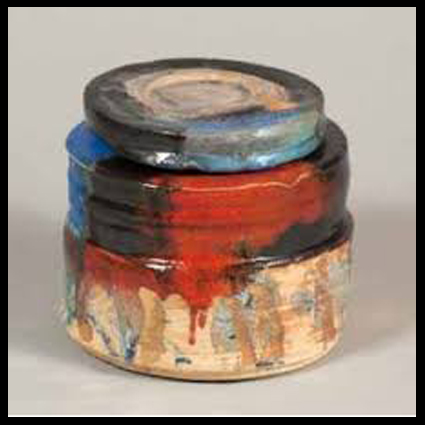
Pictures: Eduardo Constantino, portrait (source Facebook); large ceramic piece and teapot (source Facebook); lidded box (source Museu Da Cerâmica. Caldas Da Rainha Portugal).